General and Unclassified Weblog Entries
This page is for "blog" (weblog) entries that do not belong to a more specific blog stream. For examples of what I mean by "more specific blog stream" see my Kapellen, LEGO orrery, personal growth and cube puzzles entries, all of which were formulated as blogs (chronological collections of prose written on different days) but obviously have much more narrowly-focused subject matter.
(Like most blogs, and unlike most of my other writing, the material that follows is arranged in reverse chronological order: The newest material is first.
Contents
Google Plus Sparks as "Circles" (2011 Jul 30th)
The Transparent Society, Foretold (a three-part series)
I. The Dead Past (2011 May 23rd)
II. Gorby, Bert, and Barbra (2011 May 26th)
III. The Tweetbowl (2011 May 31st)
I Think I'm Learning Japanese (2011 Jan 21st)
The contraction of curricula and galaxies (2010 Oct 29th)
A random sampling of my Google queries (2010 May 21st)
Historical Origin of "Sexism" in Archetypes (2010 May 5th)
An "Official" Nomenclature for Large Numbers? (2010 May 3rd)
Facebook, IM (chat) and IRC Phishing (2010 April 27th)
Five Dichotomies of Interpersonal Politics (2010 April 14th)
What is Commitment? (2010 March 11th)
It's Milktaculous (2010 March 2nd)
Vostè ha estat assimilada (2010 March 1st)
Food Zealotry (2010 February 15th)
Translated Quote-ry is the most bizarre form of flattery (Or: Patafísica y el cerebro de pollo Jorge Borges) (2009 Oct 12th)
Searching for Affinity (2008 Apr 18th)
(Some of these articles also appear on my Blogger and WordPress blogs)
Episode Outline for South Park
2012 Dec 24th
See separate article, South Park on the Gun Debate, Without Blood or Bullets (fan fiction I wrote in December 2012).
BarCamp Boston 7
2012 Apr 7th
I wrote extensively about this on a separate page: BarCamp Boston 7
Google Plus Sparks as "Circles"
2011 Jul 30th
I have been using Google plus for a few weeks now and it seems to have a fairly good design combining the functions of a "reciprocal friends" network like Facebook with a "one-way followers" network like Twitter.
I have seen a number of comments that circles aren't focused enough — you want to be able to follow people because of your shared interest, not because of all of their interests.
Here's a solution that fits within the design of Google+:
- In addition to following people, users follow sparks (this is already implemented).
- If two different users use the same phrase to create a spark, they are following the same spark.
- When you select a Spark, a "Share What's New..." box appears at the top of the feed. It works just like a normal share (you can select circles to share with, attach links, etc.) but you are advised to only share things relevant to the spark.
- Anything shared in a Spark will also appear as a post in your stream to your followers see it. The post contains a clickable link to the spark.
- When you are viewing a spark, you can choose to show or hide the posts/shares that other people have submitted in this spark. You can also choose to view all public posts or only posts from people in your circles. This setting persists until you change it, and you can set it differently for each spark you follow.
The Transparent Society, Foretold
2011 May 31st
III. The Tweetbowl
... Because of a quirk of early communications technology, a small
group of New Hampshire girls, including me, came of age on a primitive
computer network — the Internet before the Internet.
-- Virginia Heffernan (see link [3])
I went to Dartmouth in the early 1980's, during the peak of XCALIBER, an online chatroom that typically linked 15 to 30 students at any time (day or night), including many people at other nearly schools. I introduced a friend to "the con", as we called it, where she soon met her future husband, a student at a distant school. I was skeptical of this new social medium[3] — it's too easy to cheat at the Turing test — but my friend's experience and those of many others in my circle made it clear that digital social networking would be powerful and effective.[1]
In part II, I described the Fishman Affidavit and Streisand effect, two examples of the perverse unintended consequences of trying to get between people and their information. In both of those cases, the information wasn't even of much importance or value to the thousands of people who helped spread it. But those were just warm-up acts.
With the advent of online social networking, and the new communications networks that come with it, truly important things can become the subject of grassroots political action — such as diplomatic secrets or the government of Egypt. But these social networks have also brought us the fishbowl of Asimov's The_Dead_Past.
Celebrities are the pioneers of life in a fishbowl. Few people deserve the type of suffering that results from constant scrutiny (after, probably, leading a "normal" life for many earlier years of non-fame), and privacy laws such as those in the UK aim to help prevent this type of suffering[4].
Persuant to this end, the court provides a service, (to any citizen or corporation who can pay the price), of granting a sort of individual custom-tailored seditious libel protection. This service, a form of court order popularly known as a super-injunction, orders someone (typically the entire population of the U.K. save the Members of Parliament) from talking about something, and furthermore, it orders them not to talk about the court order itself. It is a gag-order, with a gag-order on the existence of the gag-order. A sort of Double-Secret Probation for the Red top tabloid press, if you will.
Unfortunately for the celebrities, and the courts, and for us, depending on where you stand and how it all plays out when one of these court orders is enacted, it happens to go directly against one of the sole remaining provisions of the Magna Carta, which states[2]:
"We will sell to no man, we will not deny or defer to any man either Justice or Right."
Here is a good summary (on YouTube) of a serious incident from two years ago: the Trafigura affair, from the BBC programme "Have I Got News For You".
Ian Hislop (editor of Private Eye magazine) on HIGNFY
series 38, episode 1, 2009 Oct 16th
A celebrity decided to use this form of "superinjunction" after being blackmailed by a mistress who had no fears or misgivings about making the affair public. Some users of Twitter apparently felt this was a problem, and promptly published the details (well really, just the names, which was all they had to). The vast majority of retweets were positive, i.e. anti-superinjunction, and helped ensure that everyone in the UK knew the identity of He-who-cannot-not-be-named.[5] This left the celebrity and his lawyers in the amusing position of having to sue Twitter, but unable to do so without revealing his identity. You'll find it all if you search for "twitter super injunction affair", if you really care.
Celebrity affairs do not really constitute an urgent need of the public good, but something like the Trafigura affair most probably does. As David Cameron said just before I began this three-part article,
The law and the practice has got to catch up with how people consume media today.
Perhaps it is the "old world order" of the 1950's that is unsustainable, in the light of the emerging digital community.
Footnotes
[1] Dartmouth also had BlitzMail, which brought a form of instant messaging for nearly everyone on campus due to its widespread adoption and ease of use. This was just part of an overall strategy Dartmouth had already been following for 15 or 20 years prior to my arrival. Computer use was a requirement in the freshman math class, and ease of use was the primary design criterion of every aspect of the computers at Dartmouth.
[2] From Commons Debates in Westminster Hall, the 17th March 2011 Backbench Business (skip down to "17 Mar 2011 : Column 140WH")
[3] Most people do just fine balancing the risks and freedoms afforded by chatrooms. Virginia Heffernan gives a great account of her experiences with XCALIBER in her New York Times column My Wired Youth, 2008 Feb 3.
[4] The UK court actions in question limit self-expression as provided by Article 10 of the European Convention on Human Rights, when such expression would interfere with "the reputation or the rights of others", or for various reasons that are in the greater public interest.
[5] He-Who-Cannot-Be-Named: This great nickname invoking Lord Voldemort is attributed to Forbes blogger Kashmir Hill
The Transparent Society, Foretold
2011 May 26th
II. Gorby, Bert, and Barbra
If the broad light of day could be let in upon men's actions, it
would purify them as the sun disinfects.
— U.S. Supreme Court Justice Louis Brandeis
In the late 1980's a revolution in transparent society came from a seemingly unlikely place: Soviet Russia. Most aspects of that period in the USSR's history are very hard to sort out, and clearly the policy of Glasnost put in place by Gorbachev had many effects, both intended and unintended. But the contribution of technology to transparency is fairly clear.
Prior to this time, every photocopy machine in the Soviet Union had been watched by a Communist Party member who approved anything copied on it — lest it be used as an underground publishing tool[6]. The Soviets had begun to clone the Apple II and the ZX Spectrum and created several of their own designs locally. Cellular phones, satellite television and USENET were becoming more widespread[7],[8]. As all of this technology became common in the U.S. and Europe, the USSR had to keep up. A closed society was unsustainable in the long run, provided that it was to remain competitive in the world.
Information distribution can also bring about a more restrictive society. American proponents of personal privacy and free information exchange, such as supporters of the EFF, were clearly of the opinion that surveillance should be resisted in any way possible. I suppose most of them saw a downside only after 9/11.
Meanwhile, the same Internet that might have helped al-Qaeda plan its attacks in secret also gave us Evil Bert [9]. A curious chain of events led to Bert the Muppet's appearance in a pro-Osama bin Laden rally in Bangladesh, seen here. The creator of the poster had collected photos of Osama bin Laden online, and neither he nor the other anti-US protesters realized Bert's significance.
Perhaps the greatest impact of widespread communication is exemplified by the reaction to Bert's appearance in Bangladesh. Most everyone was amused by this, except for the al-Qaeda supporters and the Sesame Street workshop. Soon, the whole Evil Bert website and its mirror were taken down — but of course, it was too late. Attempts to remove a popular Internet meme fail, and usually also backfire.
The same social force that causes the spread of controversial (but deemed humorous) photographs also brings to bear upon issues of ethics and morality. This had long ago been demonstrated by the Fishman Affidavit, which showed that millions of people will copy something they didn't even care about prior to hearing of it, in the face of threats by a large and powerful organization, simply because its distribution is being suppressed for the wrong reasons. This phenomenon eventually came to be known as the Streisand effect, after a 2003 episode in which the celebrity called attention to herself by trying to avoid attention[10]. More on that in Part III...
Footnotes
[6] Los Angeles Times (David Owen), "Who Invented Xerox?", Power to the People: the Photocopier, 2004 Aug 10. Here is the relevant portion:
A telling indication of xerography's significance is that in the former Soviet Union, whose rulers maintained their power in part by monopolizing access to information, copiers were guarded more closely than computers, and individual copies were numbered so that they could be traced....
[7] InfoWorld (Paul Staffo), "Today the microprocessor is more powerful than the gun", 1991 Sep 2. Here is a part:
Within hours of Gorbachev's removal, messages were humming between the Soviet Union and points abroad via telephone and such computer networks as UseNet. One note from Moscow underscored the importance of the link: "Please stop flooding the only narrow channel. We need the bandwidth to help organize the resistance." Elsewhere in the Soviet Union, fax machines were zapping messages among resisters, while in the Baltic states, cellular phones allowed people to keep one step ahead of the events.
[8] I heard an anecdote about Gorbachev's house arrest during the August 1991 coup attempt. The anecdote states that, although Gorby's phone lines had been cut, the coup leaders did not cut off cell phone service and Gorbachev was able to call for help that way. 20 years later, I cannot find a source for this story.
[9] Evil Bert is seen here courtesy of archive.org, almost two years before 9/11. The reference to "the World Trade Center in New York City" refers to the 1993 World Trade Center bombing.
[10] Streisand sued (for $10 million in damages) the nonprofit organization that runs the California Coastal Records Project because her estate (along with every other house on the coast of California) was visible in an image on the website, and had been labeled with a caption contributed, wiki-like, by a website user. As described in a press release after the suit was rejected by the court:
...Streisand grossly overestimated the number of people who
would use the caption to download or order pictures of her blufftop
estate. In her declaration, Streisand claimed that it was likely that
thousands of people had downloaded the frame to view her estate. In
fact, prior to the lawsuit, only six downloads of that frame were
executed (out of a total of over 14,000 downloads for the site as a
whole), two of which were downloads by her own attorneys. Similarly,
prior to the lawsuit, only three reprints of the frame were ordered
through Pictopia - two by Streisand herself and one by a neighbor who
is in a lengthy dispute with her over controversial expansion plans
for her blufftop estate.
— CCRP press release
The Transparent Society[12], Foretold
2011 May 23rd
I. The Dead Past
A recent story on the BBC World Service caught my attention. Lawyers representing an unnamed football player in the UK were going after Twitter to "subpoena" records of users who helped spread news of an affair, the mere existence of which could be spoken of within the UK according to a court order.
The privacy laws as practised in England and Wales, and the court's enforcement thereof, are intended to avert some of the Orwellian[16] consequences of the pervasive media environment, by attempting to legislate and enforce a right to personal privacy. (Ironically, the celebrity mistress in question had been in the television programme Big Brother.) In this particular case the consequences were repressive, untenable (or at least "unsustainable"), and often laughably amusing to the point of complete humiliation.
I got my first really good grasp of the multiple issues involved from a short story by Isaac Asimov, which I will attempt[11] to summarize here:
The protagonist is a scientist and polymath, employed as a historian, who has been frustrated in his research on ancient Carthage. Unable to get viewing time on the government's Chronoscope (a massively expensive machine enabling one to view events in the past as if watching them live on TV), he begins conducting his own research and soon works out a way to build his own Chronoscope in his basement.
He does so, and is met with three challenges in succession. The first challenge is that the machine does not work as expected. Beyond about 100 years in the past, the images are completely washed out by static and nothing useful can be seen.
While attempting to work out flaws in the design, the inventor is confronted with a second challenge: his wife, who has yet to accept the tragic loss of their young child a few years earlier, starts using the machine to relive his brief life.
He experiences the third and greatest challenge when, while he is preparing a paper on his Chronoscope work for the academic press, he discovers that the government is tracking his activity and trying to block publication.
The government's supernatural ability to know what he is doing drives him to paranoia. After a few plot twists, and deciding to destroy his own chronoscope after his wife is reduced to dysfunctional obsession watching their dead child, he manages to get his manuscript out to several journals. Mere hours later, police surrounded his home and he is confronted by government agents.
They explain to him how they were able to stalk him so effectively, and simultaneously reveal why the government's Chronoscope is so tightly controlled: The real flaw of the Chronoscope comes not from trying to watch the distant past of 2000 years ago, nor from watching a baby take his first steps 10 years ago — but from watching events of one second ago. The Chronoscope allows anyone to instantly see everything that is happening, anywhere the viewer decides to look, violating every type of privacy with complete impunity.
The scientist then reveals that he had succeeded in getting his paper to
the journals some hours ago, and all parties, now feeling shared
remorse, realize it is too late to stop publication. Soon everyone in the
world will have the ability to spy on the present and past lives of
everyone else. The agents wish the scientist a "happy fishbowl" and
together they toast the dead past — the simpler life that will never
be again.
— (The Dead Past, by Isaac Asimov, here
paraphrased from my memory[11])
I was initially attracted to this story because of its depiction of the academic community. Like the protagonist, I enjoy invention, research, and combining ideas from diverse fields. I was bothered by the story's depiction of a society that placed severe limits on academic research (particularly interdisciplinary research, which was effectively banned). The twist ending was a good contrast to some of the other futurism-related books I was reading at the time, such as Future Shock, 1984, Brave New World and the like.
A year or two later I learned about RSA encryption through the original (August 1977) Scientific American article. My main interest here was the calculation of large integer exponents, and I was disappointed they didn't explain the arbitrary-precision arithmetic in detail. The article discussed some of the applications of one-way or "trapdoor" codes, facilitating a certain type of privacy that would clearly have significant impact in the areas of spying, criminal activity and law enforcement. I also remember wondering at the time whether these codes could make it easier for someone to broadcast a secret without being caught. There was no clear answer.
Perhaps the biggest influence on my thinking about future social and political change came from Microtechnology for the Masses, the article[13] by Jon Roland for The FUTURIST magazine in 1979. This article explored the impact of an extrapolated Moore's law on most aspects of life and society. It correctly predicted many details, such as a worldwide data network accessed through dators, hand-held devices recognizable as today's smart phones. Possessing greater computational power than the fastest computer of the day[14], and a dator would be:
... a universal personal accessory that will be more important in our daily lives than the clock, the telephone, the typewriter, television, the calculator, the recorder, the copier, the checkbook, the camera, mail, books or files, because it will replace all of these things.
This article also left out a lot, but the creative reader could extrapolate and fill in many details. It was easy to predict an end to the sale of recorded music; somewhat harder to see whether the "datornet" would foster or discourage crime.
(Parts II and III are planned within the next few days)
footnotes
[11] The Dead Past : I have not read the story in 30 years, but the memory seems clear enough. I'll have to find my copy to see how much I got right...
[12] The Transparent Society: Will Technology Make Us Choose Between Freedom and Privacy? is a book by David Brin.
[13] Jon Roland, The Microelectronic Revolution. The Futurist, April 1979.
[14] The fastest computer at the time of the Futurist article (April 1979) was a Cray-1. A present-day smartphone is at least as fast; see [15].
[15] Michael Croucher, Supercomputers vs Mobile Phones, ("Walking Randomly" blog article), 2010 Jun 2.
[16] See Nineteen Eighty-Four by George Orwell.
I Think I'm Learning Japanese
(I Only Think So)
2011 Jan 21st
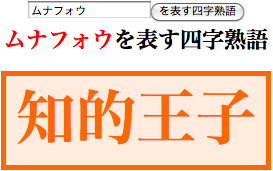
"Munafo" = "Intellectual Prince"?
(from usokomaker.com/yoji, a novelty yojijukugo generator)
For various reasons, Japanese language and culture have interested me throughout my life. (A few of the reasons, like トトロ, are commonly known and will be familiar to readers. Others, perhaps less so (possibly NSFW themes and language).)
For many years I only knew a few basic facts: there are three alphabets, all derived originally from Chinese, plus the Hindu-Arabic numerals and our own Latin alphabet, and you pretty much have to learn all of them to get along in daily life. The pronunciation of two of the alphabets is simple and logical, but the third (kanji, the Chinese characters) includes thousands of special cases with little structure or pattern.
The depth and complexity of Japanese, for which it is justly famous, have kept me from doing much more — until just recently, when I have decided to adopt a religion [17] and consequently travel to Japan to visit the head temple.
When I travel to a place that speaks a different language, I want to be able to read and write certain basic things: numbers, times and dates, the address(es) where I will be, etc. Apart from being prepared (the State Department emphasizes the importance of such things), it is fun, and seems to me an act of basic courtesy to try to learn at least a little bit of the local culture.
My ordinary way of learning involves a lot of computer and Internet use. Methods of entering Japanese katakana and hiragana are relatively direct and obvious. You can type totoro to get トトロ (in katakana, as this is a nontraditional proper name), or fujisann to get ふじさん or 富士山 (the native pronunciation and spelling, respectively, of the famous mountain overlooking the temple I will be visiting[18]

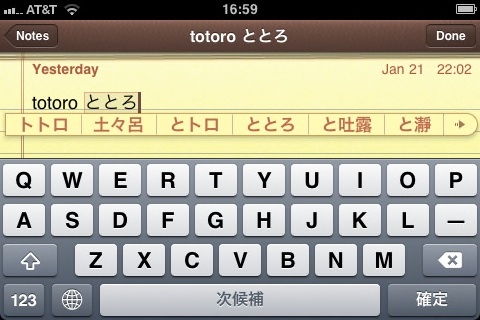 entering katakana |
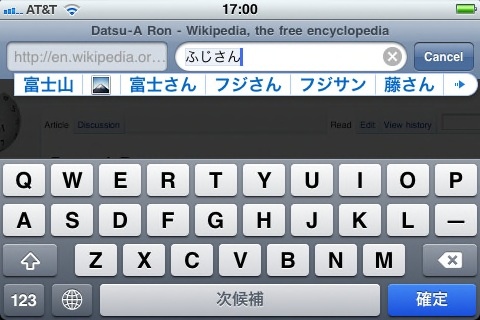 entering hiragana |
However, typing in katakana and hiragana is only good enough for looking up proper names. The majority of Japanese writing uses the kanji extensively. Most kanji have at least two pronunciations and multiple meanings. In addition, the partial redundancy[19] of hiragana and kanji means that there are usually two or more ways to write any given word or phrase.
When learning any language there are 4 things to learn (listening, speaking, reading and writing). Whereas in most languages this corresponds to 4 skills, which (for the adult learning a second language) can initially be approached through transliteration and translation respectively, the Japanese situation with three alphabets, two or more pronunciations and two or more spellings makes it more like 10 or 12 skills.
The learning curve is a seven-dimensional manifold.
These 10 or 12 skills are inter-related and interdependent. You don't know which way something will be spelled or pronounced, so it is important to learn both (all) of the alternatives.
Let's Just Learn the Writing
At this point I thought — Perhaps speech and listening/understanding can be put aside for the moment — what if I put the spoken skills aside and focus just on reading and writing?. I should still be able to look up Japanese kanji in a dictionary or on Google to find a definition. But that presents another problem, which may strike computer-savvy readers as uniquely odd or even impossible:
In order to be able to type in a kanji character, one must know either how to say it or how to write it.
And by "write", I mean nothing less than the ancient traditional art of brush-and-ink calligraphy.
As it turns out, thousands of years of experience have led to a greatly standardized stroke order for each of the thousands of commonly-occuring characters, and the system is so useful that it is identical in all of the cultures that use the characters (primarily those who speak some form of Chinese, Japanese or Korean). The stroke order gives rise to a convenient and efficient software optimization for handwriting recognition, which can be adopted and used by all native speakers because no-one writes any of the kanji any other way.
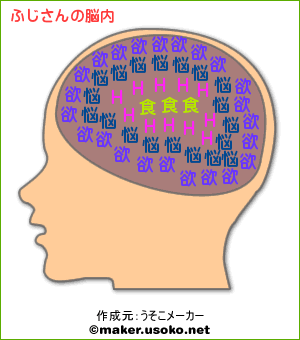
So in order to so the most basic and modern task (say, looking up "富士山" on Google Images) I need to learn one of the most ancient and decidedly non-modern tasks (how to paint "富士山" with a brush!).
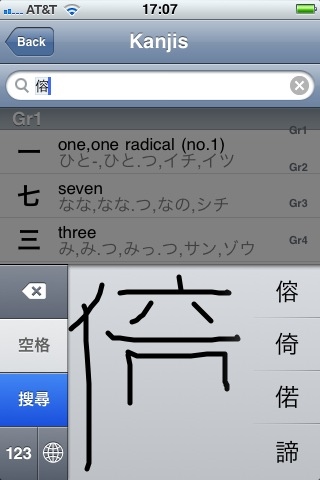
Entering a Kanji without knowing its pronunciation
(showing a partly-entered "億" (おく, "100,000,000")
This need to know stroke-order in order to look things up in Google is both a curse and a blessing. Simply being able to produce an accurate drawing of the character is not good enough. You have to draw each line in the correct order. This can be very frustrating for beginners, but that is far outweighed by the benefit: one can practice and learn Kanji writing just by trial-and-error in the computer interface.
An Epiphany
It was sometime in the afternoon on January 10th, stumbling through a few of the dozens of equally unlikely ways of writing "蓮" (れん, "lotus"), that I had the stunning insight: Each part of each kanji has its own specific writing order, and is always drawn the same way each time it appears. In this particular case, for example, I can start by learning how to write the "車" (くるま, "car") and the "辶" (チャク, "walk"[20] simplified as radical 162), and the first of these uses "日" (にち, "sun" or "day"). These smaller building blocks each have far fewer possibilities to try, and once I learn them I not only have a fighting chance at drawing "蓮", but am also much more prepared to use any other character that uses any of the same parts (such as "億", shown above, which also uses "日").
This is of course only the second or third thing anyone is taught if they study Chinese writing the "proper" way (like, say, from a book or a teacher). In fact, a friend told me about this in 1982, when I first got curious about Chinese writing. But it kind of slipped my mind somewhere along the line, and it was really cool to figure it out (again) on my own. These kanji building blocks (many of which are "radicals", but many are not) are like little graphical subroutines — very appealing to my computer programmer aspect.
Footnotes
[17] adopt a religion : I do not proselytize, but if you are curious it is Nichiren_Shōshū. The reasons it appeals to me are the relative peacefulness (and lack of political dictation) of Buddhism in general combined with the prominent role of large numbers [21] in the most important source text, the 16th chapter of the Lotus Sutra. (There is a widely available translation by Burton Watson).
[18] fujisan : Note that fujiyama (ふじやま) is a common Western mistake: 山 is usually やま but not in this case.)
[19] redundancy : The written alphabets, including the kanji, came to Japan after there was already a distinct Japanese spoken language. The kanji were used wherever a Chinese character (or combination) was directly suited to represent a word. Often, but not always, the Chinese pronunciation was used for the Chinese character. Anything for which there was no word in China, including Japanese conjugations and declensions, etc. had to be represented with extra letters representing their sound (phonetic value). Since the kanji have a pronunciation (and usually two: Original Chinese and Japanese), they too have a phonetic value, and one could just use just a phonetic alphabet. Often you see both: little kana written above or next to the kanji. There are many situations in which that is preferred (writing by or for young or uneducated readers; texts that would otherwise use rare or obscure kanji, instant messaging, etc.) but the reader cannot count on it.
[20] 辶 : This is a derivative of "辵", which my Kanji dictinary does not know about (probably because it is not taught in schools). I like it a lot better than the modern alternative, which seems to be "歩" (taught in grade 2) because it puts the "steps" (彳, "walk" in an idiosyncratic form 彡) before the "stopping" (止)
This character reveals some of the flaws in modern integration of computer technology in our culture. Your computer might show "辶" with three strokes or four:

Compare the page title (top) with the article title.
Wikipedia's article on Hyōgaiji notes:
A related weakness (though less relevant to modern language use) is the inability of most commercially-available Japanese fonts to show the traditional forms of many Jōyō kanji, particularly those whose component radicals have been comprehensively altered (such as [...], and 辵 in 運 or 連, rather than [the traditional form used in 迴]). This is mostly an issue in the verbatim reproduction of old texts, and for academic purposes.
These old and/or rare characters (hyōgaiji) are of great interest to me, as the primary application of my Chinese and Japanese learning will be research on large numbers[21].
[21] large numbers : The Chinese Buddhist quantity "阿僧祇" (Sanskrit asaṃkhyeya, Japanese asōgi) means "incalculable" or "innumerable". As a number it can mean anything from 1056 (in common modern usage, see Wikipedia "Chinese numerals") to 10140 (see asaṃkhyeya) to 107×2103 = 1070988433612780846483815379501056 (as seen in the Chinese Wikipedia article on Chinese numerals, item 103 of the long list in the "大數系統" section).
But there are far larger numbers, on the order of 10↑↑(105×2120) where ↑↑ represents the hyper4 operator or iterated exponential function. That is a "power-tower" of 10's a googolplex of 10's high. See novoloka's article on Avatamsaka numbers and go down to the note at the bottom. Note the description that begins with "The first four verses of this poem are most challenging. They apply a superexponential iteration over an exponential one." For more detail see their article measuring the asamkhyeya.
The contraction of curricula and galaxies
2010 Oct 29th
A reader asked me what I thought about the limits of defining large numbers.
Such discussions begin with specific arithmetic operations and mathematical symbols in mind, and usually focus on comparing one system (such as Conway's "chained arrow notation") to another (such as "Bowers' extended operators"). The choice of symbols and operations affects how high one can go, and such discussions usually devolve into competitive games, the limits of which are fairly well handled by the Turing machine and the Lin/Rado "busy beaver function".
But such discussions usually come out of a more universal question, which regards the limits of human thought and perception in general.
Limits of human thought and perception are apparent throughout the history of numbers and mathematics. After a survey of early human developments (such as is presented in the nearly exhaustive "Universal History of Numbers" by Georges Ifrah, ISBN 0-471-37568-3) one might notice some patterns:
- Perception and understanding are limited by the symbols in use and the concepts they represent,
- Mastery of a given set of concepts leads to invention of new symbols and concepts.
At any point in history, or within any specific culture, there is a specific set of ideas and symbols which creates (or perhaps reflects, or both?) a natural limit of the capacity of the mind to perceive (say) large finite numbers.
It has been the trend throughout our history that the intellectual developments of earlier generations become assimilated into the body of common knowledge and added to the standard educational curriculum. As new material is added, earlier material is often compressed and taught (usually with greater efficiency) in a shorter period. So it is that the most advanced arithmetic of the early Babylonians is surpassed by that learned by today's 8- and 9-year-old students, and most of the algebra techniques of 9th century Arabia are (typically) learned by 13- or 14-year-olds today, and so on. Both are aided by more recent developments (Indo-Arabic numerals aid arithmetic; certain new teaching methods address the abstraction of variables in algebra, etc.)
Speculating about the limits of the human mind (or brain, for reductionists) can lead to discussions that test or challenge religious beliefs. I suppose the majority opinion in most cultures would state that the human mind has some kind of ultimate limit, which can be compared to the limited physical size of the human brain. (Such a conclusion helps to distinguish believers from God, avoiding blasphemy).
A universe, assuming it is also limited in size (or a visible universe as limited by an event horizon or light cone) would therefore also have a finite limit.
The development of our culture over thousands of years is a bit like an expanding light cone. The contraction of the curriculum into ever-shorter stretches of childhood is like the Lorentz contraction of galaxies known to be much further away, and therefore seen in a remote past, when the universe and the visible universe (our view of the world and the sum total of knowledge) were both much smaller.
A random sampling of my Google queries
2010 May 21st
On the weekend of the Pac-Man doodle, a friend asked me if I had "Googled anything lately", intending simply to help me discover the playable throwback game (which at the time had sound).
Misunderstanding his request, I prepared the following snapshot of my recent search activity.
Thursday, May 20, 2010 (yesterday)
10:32 PM: "system preferences" network "dns servers"
I was finding out how to use the Google DNS servers, which were indicated on a discussion forum as a way to fix a problem with certain YouTube videos not loading.
3:49 PM: "the band" discography "pepote"
I like to have accurate date tags (for popular music, the year it was on the charts; for classical, the year of debut performance). Here I was filling some missing dates. Many albums such as greatest-hits compilations are tagged with a re-mastering or re-release date, which is meaningless for me.
Wednesday, May 19, 2010
11:26 PM: when the tide comes in all of the boats rise
A metaphor that one of my friends likes to use; he had T-shirts made, and today I wondered where the quote came from. It was originally used by JFK in 1963 when he was promoting spending federal funds on the Greers Ferry Dam in Arkansas.
11:16 AM: Coercive Persuasion "foot in the door" "love bomb"
I frequently look into new ideas and concepts relating to sociology, and one area I often write about is the balance of power between the individual and the group. Here I was trying to find an old reference that I had lost.
1:04 AM: perl bigint
Discovering how to use the Math::BigInt library, which allows arbitrary-precision calculation in Perl.
Tuesday, May 18, 2010
11:53 PM: pdflatex atsutil and MacTeX
I was getting my TEX typesetting system up and running on the Mac Pro.
9:23 PM: Islands of Adventure Harry Potter
Learning about the new theme park area that is opening next month.
5:52 PM: xkcd forum playpen balls
There was an xkcd cartoon in which someone filled their room with those brightly-colored baseball-sized hollow plastic balls, I wanted to find the discussion that would reveal whether such a thing was practical (best price: roughly $8000 for a typical size bedroom).
5:20 PM: sloane integer sequences
I use this site a lot (The On-Line Encyclopedia of Integer Sequences) and this time I was too lazy to find the link in my bookmarks page, so I did a Google search instead.
2:46 PM: translate portuguese
I used Google to try to figure out how to say something in Portuguese.
2:33 PM: 19111438098711663697781258214361
This number is the first in a set of consecutive prime numbers where the difference between each one and the next is the same number (in this case, 7 primes with a difference of 210), called a "CPAP". It is one of the entries on my numbers page, and I was looking to see if it was still the record-holder for smallest CPAP-7.
Monday, May 17, 2010
5:55 PM: ffmpeg me_method dia_size
Solving a problem with the program I use to convert JPG files to MP4 video for YouTube uploads (mainly for my Gray-Scott simulations). YouTube does not like the format of the ffmpeg output (the atoms are not ordered properly for streaming) and directs users to a help/support page that is entirely irrelevant because it only addresses iMovie, Final Cut, or QuickTime.
2:59 PM: Jefferson Airplane discogs
Finding more dates of old music.
1:54 AM: ezekiel chronology and 360 days prophetic year, etc.
Filling a few details in the entry for 945000 and some related entries on my numbers page.
Historical Origin of "Sexism" in Archetypes
2010 May 5th
I often speak with men about archetypes and the lessons they can teach about our behaviour and group interactions. Recently, one man objected to the notion that I could claim to understand the "feminine" archetypes (such as the Seeker and Crone), while another man objected to the notion that men should be encouraged to be aware of and to embody the abilities represented by the "feminine" archetypes. I also encountered a man who objected to these other two views, and believed that all of this was the result of "sexism" in our treatment of mythology, culture, and attitudes towards all aspects of psychology and sociology.3
To sort this all out, I will begin with a simple "two-sided" category system. However, I do not assign anything specifically to males or females, or to what one might call "masculine personality" or "feminine personality".
The main division I use is between "communication, perception and understanding" on the one hand, and "deduction, decision and action" on the other1. Note that each occurs equally often in any living thing that exhibits behaviour, regardless of sex or gender. Also, each of these two categories includes physical, emotional and mental aspects. For example, communication can be mental (through words), emotional (facial expressions) or physical (touch, gestures, watching someone move around a room).
The first category (communication) happens between two or more people, while the other can involve a single person or more than one. If you believe in the autonomy of multiple parts of the mind (the id, ego, and super-ego, an inner child, etc.) then there is "communication" inside the mind. I consider this to be part of "decision": you are using several of your skills at the same time. Awareness of the multi-part mind is fairly recent, and is too sophisticated a concept to be relevant here.
In ancient times when story-tellers "taught" wisdom they usually did so through fables involving characters2. Many of the stories that were being told concerned psychology, behaviour, ethics and morality, group interaction, and so on — the kinds of things I am discussing when I refer to "archetypes" and why they are important.
I believe that when the story-tellers wanted to discuss a lesson related to communication, they told the story with a female character. When they wanted to discuss a lesson related to action, they chose a male character for their story.2
What happens if a young child is given a vaugely-defined object (say an oddly-shaped piece of wood) to play with? A boy is likely to pretend the object is some sort of tool or weapon, and a girl is likely to treat it like a baby or doll. There is a big nature versus nurture debate regarding this phenomenon, but it does not need to be resolved here. The only thing we need to agree on is that this phenomenon also affected the story-tellers' choices of what characters to use in their fables2. (Of course, once they made such choices, the resulting oral tradition would have helped amplify the existing gender role bias in the culture).
This use of gendered characters in fables led to a gradual accumulation of culture knowledge (some of it subconscious) linking lessons to gender-roles. These lessons covered all the areas I listed above (behaviour, morality/ethics, group dynamics, etc.).
Over time, human cultures accumulated a vast body of literature (myths, fables, stories, etc.) containing lessons about behaviour, most of which can be classified into one or the other of the categories I set out above. Lessons regarding communication/perception/understanding are more likely to use female characters, and those regarding deduction/decision/action are more likely to use male characters.
The archetypes have been derived from the mythology fairly recently (e.g. by Jung, Moore and Gillette). The treatment of them as "masculine" and "feminine" is a convenience of nomenclature for those who study and understand the mythology. In general, a Jung/Moore/Gillette "masculine" archetype unifies lessons and wisdom imparted by myths/fables/stories that use male characters.
The association of these with actual male and female people (as distinguished from mythological characters) is an unfortunate accident caused by the terminology.
In other words, our current use of "male" and "female" to refer to the archetypes has no relevant connection to the use of the words "male" and "female" to refer to people — or to the use of "male" and "female" to refer to electrical cable connectors! This is much like the treatment of such words in the east (see for example the relation between male and female in the yin and yang distinction.) It is no surprise to me that eastern thought has less trouble with the gender words.
Given the problems of "sexism" in teachings that are meant to illustrate the same psychological principles in all people regardless of sex, it might be useful to purge all gender names from the archetypes entirely — but that will be a lot of work. Moore and Gillette describe 24 "masculine" archetypes, and there are another 24 on the "feminine" side (see my table). Nearly all of them have genderized names. That's a lot of names to change!
Footnotes
1 : Or more simply, "relationship" and "task".
2 : human characters in fables : Of course, actual history is more complex than this. Many of the earliest known fables used animal characters, not human. According to Joseph Campbell, all mythology began with animal religion and animal symbolism. However, most of the animal stories eventually evolved into a more sophisticated mythology involving gendered (human or human-like) characters. It was during this evolution that the story-tellers were able to choose which gender to give each character.
3 : 15 years after writing this article, a trans woman pointed out that there remain some patriarchal influences in descriptions of the feminine archetypes, even those given by female authors who are well-respected as being true to the nature of femininity. In other words, there is culture-wide implicit bias enbodied in verbal descriptions of what those four feminine dimensions embody.
An "Official" Nomenclature for Large Numbers?
2010 May 3rd
A former co-worker recently told me that his son has been learning (with his help) about very large numbers, including the Graham-Rothschild number, and asked me "if I know of any more 'official' nomenclature [for] numbers higher than centillion".
The higher the numbers go, the less official the names get. I have written much on this in the first section of my Large Numbers page.
Most folks who ask this question want to go more than just a little bit beyond centillion (10303 or 10600). Let's use 1012345 and 101027 as examples.
The only really official nomenclature is to say, for example, "ten to the power of ten to the power of twenty-seven".
I would give the prize for "second place" to Conway and Guy, The Book of Numbers (1996) pp. 13-15, who set out the system that I describe here. Under their system, 1012345 is "one quadrilliquattuordecicentillion" and 101027 is "ten trestrigintatrecentillitrestrigintatrecentillitrestrigintatrecentillitrestrigintatrecentillitrestrigintatrecentillitrestrigintatrecentillitrestrigintatrecentillitrestrigintatrecentilliduotrigintatrecentillion".
I think the Knuth -yllion system would come in third; under his system, 1012345 is "ten myllion byllion tryllion decyllion undecyllion" and 101027 is "one quinvigintyllion septemvigintyllion octovigintyllion novemvigintyllion duotrigintyllion trestrigintyllion quattuortrigintyllion quintrigintyllion quinquadragintyllion quinquagintyllion duoquinquagintyllion tresquinquagintyllion quattuorquinquagintyllion quinquinquagintyllion sesquinquagintyllion septenquinquagintyllion octoquinquagintyllion unsexagintyllion quattuorsexagintyllion quinsexagintyllion sesexagintyllion septensexagintyllion unseptuagintyllion duoseptuagintyllion treseptuagintyllion quinseptuagintyllion octoseptuagintyllion novenseptuagintyllion unoctogintyllion duooctogintyllion tresoctogintyllion sexoctogintyllion septemoctogintyllion".
As you can see, systematic names for large numbers become unwieldy if you attempt to follow the classical system of giving names to each power of 10 (or powers of 1000 like Americans do today, or of a myriad as the Greeks and Chinese did, or of a million like Chuquet).
All of the other systems I have encountered are ad-hoc, unresearched and/or poorly thought out, imitations of the Chuquet names with clumsy or inconsistent decisions regarding how to proceed once the Latin ordinal number names run out. I describe some of these here.
The names googolplex for 1010100 and googolplexplex or googolduplex for 101010100 are fairly well-known. The number 1010101010000000 appeared in a 1994 journal article by Zarko Bizaca. Going beyond these, to numbers that are unwieldy to represent even as a succession of exponents:
Several academics (mostly mathematicians like Graham) have had to invent recursive function definitions to describe large finite numerical quantities, as part of a proof of some kind. As far as I have been able to tell, each such system is incompatible with every other such system.
Jonathan Bowers seems to have given more thought to this than anyone I have read about or been in contact with. His names (like exillion, tripent, baggol, trissol, dutridecal, goppatoth, golapulus, meameamealokkapoowa, and so on) are just convenient, arbitrary nicknames for various specific examples of his array notation and its multidimensional extensions. The array notation, in turn, is shorthand for a very complex set of recursively-defined functions.
Recursively-defined functions like those Bowers develops are extremely difficult to understand, and given two different recursive definitions, it can be even more difficult to prove which produces the more quickly-growing function. I am not sure how he developed his functions but I am reasonably confident that most of his claims about them are accurate. Checking his work is well beyond my patience, if not my ability. Bowers' keen abilities of comprehension are also evident in his descriptions of multi-dimensional geometric structures ("polychora", which are like polyhedra but with more dimensions).
Facebook, IM (chat) and IRC Phishing
2010 April 27th
I caught a Phacebook Phisher today! It was someone impersonating a friend and asking for my phone number.
Tell-tale signs:
- A Chat or IM or IRC msg apparently from a friend, but saying nothing specific about them or about you
- Writing in a generic style possibly atypical of your friend's normal style
- They reply to your messages with no delay
- Urgent or repeated requests for info (like your phone number)
- Logs out or goes offline after only a couple minutes delay on your part
How to reply:
- Tell them to contact you by some other means which would require them knowing something specific (like their own email password), but
- Don't tell them that specific thing, and don't tell them what they're asking for via the IM or chat.
Likely Hacking Method
In this particular instance I believe the hacker got a Javascript running on my friend's computer. The way this can happen to you is as follows:
- You can visit a website which runs a Javascript (typically through a banner ad) that sticks around and later acts as a "chat relay".
- The script waits until you are in Facebook, then opens another window that is invisible (for example, hidden below the task bar)
- Within the hidden window, it starts a Chat with any friends who are online.
- If a friend responds, the script (running in your browser) forwards your friend's response to the hacker (who is somewhere else on the Internet).
- Your friend can then chat with the hacker, who impersonates you.
More details of other types of phishing are at http://www.facebook.com/group.php?gid=9874388706
Five Dichotomies of Interpersonal Politics
2010 April 14th
First a couple limiting qualifiers:
- I do not imagine these to be the only five, or the most important five, dichotomies. They just happen to have been on my mind lately.
- By politics, I simply mean the ways in which people interact while deciding what to do.
These dichotomies exist as characteristics/traits of people, as ways of behaving or interacting, and as points of view — and most are a combination of all three.
In no particular order, here they are:
1. The Personal vs Team dichotomy is strongest in situations where several people are working together and risk their individual well-being in order to achieve important results that benefit all. I discuss this and give examples in MCV03, Everything That Depends on You Depends on Your Well-Being.
2. The dichotomy between Individualism and Collectivism is similar but involves the tradeoffs between the individual(s) and a much larger entity such as an entire society. This dichotomy often factors in political ideologies, such as Ayn Rand's Objectivism (which falls on the individualist end of the spectrum) and Socialism or Communism. I have written a bit more on my Collectivism page.
3. There is a dichotomy between Task and Purpose, or between the means and the end, or between the method and the ultimate result. I think of this as a succession of several things connected in a chain. Roughly in order they are: Task, Goal, Project, Mission and Purpose. They have a cause-and-effect relationship, in that each results from the ones that come before it in the chain. Also, at any point in the chain, there are typically several alternatives any of which can be used to achieve the next link in the chain. I have written a lot about this on my Priorities page.
4. That dichotomy relates closely to the dichotomy between One-Time Planning and Ongoing Re-Evaluation. This is a spectrum of individual preference; each person will tend to choose how much energy to spend on thinking and planning, and how much risk to take from the adverse effects of failing to adapt or to be flexible. I discuss this on my Decision page.
5. Finally, there is a dichotomy of management style between Hands-Off Management and Micro-Management. This appears when decisions are being made about what how to carry out a task or how to accomplish the results expected in a person's job. There is a spectrum, ranging from a completely worker-oriented extreme at which the person doing the job decides how to do it, to a completely manager-oriented extreme at which every detail is specified to the worker by another person, or perhaps by several or many others.
What is Commitment?
2010 March 11th
I was recently asked for my opinions on the following questions:
What is a commitment? Why make them?
What is important to do/be when giving your word?
What is important when you are accepting another man's word?
What is the best way to deal with success (kept commitments) and
failure (broken commitments)?
These are common questions in a volunteer group that I participate in.
"A commitment" is simply a promise, which often engenders expectations on the part of others.
"Commitment" (in the more general sense) is the personal dimension of ownership; there is also a communal dimension of ownership which is empowerment. Total ownership cannot exist and the endeavor will fail unless both dimensions (commitment plus empowerment) are present in suitable quantities.
All commitments have a level of priority, a level of importance, and a level of urgency (the priority matrix method). It is not always true that one of these implies either of the other two. The biggest pitfalls in dealing with commitment issues come from getting one's priorities screwed up. This applies to individuals as well as groups. In most of the interesting situations there is no simple answer to a question like "which takes priority?".
Why make commitments? Teamwork. If you are dealing with a new challenge, the communication and successful follow-through of commitments are what enable coordinated action in groups. (It is not always required for teamwork: once the team has learned how to work together on a given type of task, they can usually get it done more efficiently by dispensing with the planning, talking and micromanaging.)
What is important when making and recieving a commitment? Complete and accurate communication. Each party has to understand what the other thinks is being committed, and this has to cover as many possible future contingencies as you can find time to discuss. Consider the downsides, that's how we got 24 men to the moon without losing any of them. Cover all the bases; don't bluff someone into committing by not telling them what your expectations are for each contingency. Jobs should be cleared thoroughly and in detail, the same way companies interview employment candidates.
I have written much more on all these issues here:
And also the following shorter articles:
It's Milktaculous
2010 March 2nd
The milk industry seems to enjoy having fun with their advertising campaigns. A brother from my college fraternity wrote:
Subject: Drink More Milk, brought to you by Canada
What's up with the crazy Vancouver dairy people?
As milk advertising goes, the above is very tame. I responded:
I see your milk stop frame animation short, and raise you a campy retro rock opera featurette.
Take a look at The Battle for Milkquarious
The Battle for Milkquarious, by the California Milk Processing Board. Hosted by Creativity Online.
All-student version released after the end of the contest.
(In the contest, California high-school students submitted videos, with several prizes of grants to school arts programs.)
My frat brother friend replied:
I bow before your rock opera. Remind me why I don't write musicals again? Oh yes, something about "copious spare time"...
And bow you should — it's nothing less than milktaculous.
I happen to be a lifetime fan of cows and all things dairy, provided that it's not too bitter or sour (why did anyone ever start making cream go sour on purpose?!?!?) and tend to think the politics of anti-dairy zealots are blown rather far out of proportion: Smoking is bad for you, and so is an excess of fat, salt, or sugar — but there are people I know who'd rather whine about the advantages of goat milk over cow milk. These aren't people with a medical issue, they just want to be anti-establishment.
Vostè ha estat assimilada
2010 March 1st
A friend emailed me today with a link to this image of the Eixample of Barcelona and the comment:

How do you say You have been assimilated in Catalan?
The "assimilated" quote is a reference to the fictional Borg, a notably collectivist society of virtually identical extraterrestrial aliens that have constructed a cubelike "hive" of many roughly identical rooms and passageways.
I checked into the history of Barcelona's street layout — it turns out the identical city blocks you see in the photo are the result of deliberate planning, in 1859, by urban planner Ildefons Cerdà i Sunyer. In [25] I found:
In Cerdà's project, almost all streets were straight and distributed in a regular geometrical grid with perpendicular intersections (see Figure 1). The city blocks all had the same octagonal shape12. According to Cerdà, this regular distribution was mainly aimed at avoiding privileged building zones.
Figure 1 showed this 1859 map by Cerdà; and footnote [12] reads:

[12] There were about 1,000 blocks, each one size 113.3 m x 113.3 m.
In his day Cerdà was accused of being a socialist (the goal of "avoiding privileged building zones" came from this idealism — he was trying to prevent some parts of the city being rich neighborhoods and other parts being poor), and other politicians tried to block his plan but it was adopted and mostly implemented.
In a way, socialism is a real-world expression of the Borg mentality. As perceived by the Star Trek writers, the Borg, socialism and communism all share an "everybody-work-together, everybody-benefits-equally" idealism. And in the United States, identical houses and tract developments are often seen as evidence that individuality and artistic expression have been suppressed.

So my friend's Borg comparison is quite appropriate. The title of this entry was provided by Google Translate.
Footnotes
[25] Eduardo Aibar and Wiebe E. Bijker, Contructing a city: the Cerdà plan for the extension of Barcelona, Science, Technology and Human Values 22 (1) pp.3-30, 1997. Available here.
Food Zealotry
2010 February 15th
My conversations with friends often end in a bizarre sequence of increasingly resolute claims followed by a sudden change of subject or silence. A typical example was today's exchange on the topic of oatmeal. It went roughly like this (I for me, F for my friend):
I: For many years I avoided oatmeal because it reminded me of my chemotherapy. I had been eating oatmeal in the mornings before the chemo and I learned to associate the subsequent nausea with the oatmeal. Oatmeal became permanently unappealing. Every 5 or 10 years I have tried it again. This last time, I found that I can eat oatmeal again! F: That's great — oatmeal is pretty healthy. It helps you control your cholesterol levels. I: Yeah, I heard that. And it's pretty easy to make, I use the instant oatmeal that comes in small packets. F: Oh, no you shouldn't eat instant oatmeal. I: What? — Instant oatmeal is the same as non-instant oatmeal, it's just been boiled and then dried out. (sudden silence — a pregnant pause — and a change in topic)
My friend couldn't go on, because he had just discovered that in fact he didn't know what he was talking about. There is one good reason to question instant oatmeal: the processing method might remove fiber content. My friend could have said that — it's a pretty simple thing to learn and to remember. And if that were the problem, it's easy to address too — just read the package (a commonly-cited goal is 3 or more grams of nutritional fiber per serving).
I now suspect he doesn't even know the difference between "oats" and "oatmeal" (I'll save you the embarrassment, and the trouble of looking this up: they're the same, except that oat "meal" has been crushed, cut and/or ground into smaller pieces, so you don't have to boil it as long. It is a completely mechanical process.)
In this case, the only practical upshot of our discussion was to confirm my characterization of him as a food zealot. I know lots of food zealots. Most of them are dead set on trying to get other people to do what they say: they're politicians, self-appointed leaders attempting to wield power one person at a time. The zealotry is usually driven by a sincere desire to do good and address some cultural evil; in this particular case, the cultural evil (as perceived by my friend) is a common American delusion: a simplistic belief that any food which is fast and/or easy must be unhealthy and should be avoided. (A similar delusion targets all tasty foods. The anti-tasty zealots and the anti-fast zealots must be eating a lot of grapefruit and pomegranates — they occupy the difficult-untasty quadrant of the fruit universe).
This type of "zealotry" is part of a much larger phenomenon of political behaviour seen in inter-personal relationships. There is an abundance of negative-judgmental labels: self-made victim, drama queen, bully, manipulative, vindictive, and so on. I know a few of each.
Fortunately, one can address all of this pretty easily with a simple technique. Let's call it "The Three P's of Speech Attitude":
Personal : Speaking "personally" can be done by beginning everything you say with "I" or "my". For example, I prefer not to eat instant oatmeal. Personal statements carry one really big advantage: they are much easier for people to accept on their own merits.
Positive : This simply means replacing any negative attitudes and terminology with positives, and rephrasing questions such that the desired answer is yes. For example, I prefer to eat regular oatmeal (Notice no more use of "not", and replacing the demonized "instant oatmeal" with something the speaker actually feels good about). If I can't find a positive way to say it, I also consider saying nothing at all.
Proof : When I insist on a statement that doesn't adhere to the first two P's, I try darn hard to be ready to prove it. Proof is in the domain of Persuasive speech — another P that is well beyond the scope of this little article. I read a couple articles on that topic and concluded that it would be far easier just to add the words I believe that ... to whatever I was going to say!
Translated Quote-ry is the most bizarre form of flattery
(Or: Patafísica y el cerebro de pollo Jorge Borges)2009 Oct 12th
In 2000, I put a geeky but otherwise seemingly innocuous joke on my personal bio page. Five years later, it kept a whole blog-forum full of Spanish-speaking websurfers puzzled, and I didn't even know it. Their discusson led me to discover something quite insightful.
The webpage is www.microsiervos.com/archivo/frases-citas/cita-paradoja-munafo.html. Here is how they quoted me:
09 Jun 2005 Paradojas
Cuando rompo con alguien un hueso de pollo de la suerte el deseo que pido es que se cumpla el deseo de la otra persona. A continuación puedo hacerle la observación de que, o bien el hueso, o bien el universo, deberían dejar de existir de repente.
— Robert Munafo Publicado por Alvy # 9/Jun/2005 Categorías: Frases, Citas
I do not know any Spanish. Someone translated something I wrote into Spanish in order to quote me. Bizarre, but it gets better... I'll give you my original quote first:
When I break a wishbone, I wish that the other person get their wish, then point out why the wishbone or the Universe should have spontaneously ceased to exist.
This was intended to be a joke, and a self-contradicting logic scenario (like the philosopher who encounters a liar and a truth-teller at a crossing in the road). It turns out not to be a paradox at all (as my microsiervos readers pointed out; answer below). I used an auto-translator to render my words back into English:
When someone break a chicken bone of luck I ask is the desire to fulfill the desire of the other person. Then I can make the observation that either the bone, or the universe, should suddenly cease to exist.4
Okay... so far so good. Brace yourself...
#2 Alex M.
No lo entiendo :S
I do not understand :S
#7 Alvy
La tradición es que el hueso lo parten dos personas, ambos piensan un deseo, a la que se queda el trozo más largo con el huesecillo central se le cumple el deseo, a la otra no se le cumple.
Por tanto, si una persona desea que se cumpla el deseo de la otra y gana el juego, entonces se produce la paradoja porque el deseo de la otra NO debería cumplirse pero se va a cumplir.
The tradition is that the bone is split two people, both think a wish, which is the longest piece with the central ossicle desire is fulfilled, the other is not satisfied.
Therefore, if a person wishes to fulfill the desire of the other and wins the game, then there is the paradox because the desire for the other should not be met but will be enforced.
#15 El Pollo
Devuelvanme mi hueso, y dejare existir su universo.
Give me back my bone, and his universe ceases to exist.
#18 18
Otra paradoja está en desear quedarte con el trozo más peque~no del hueso.
Y la estupidez está en desperdiciar el deseo deseando el trozo más grande.
Another paradox is wanting to stay with the smaller piece of bone.
And the stupidity is willing desire to waste the largest piece.
#20 Gaona
Si la tesis inicial fuera que solo pueda cumplirse un unico deseo (es decir que uno gane y el otro pierda), la hemos liado!
Me pido croquetas.
If the initial thesis was that only one wish can be fulfilled (ie that one win and one loss), we have bundled!
I ask croquettes.
#23 banpiro
No,venga,tratemos ahora el tema que nos preocupa mas a todos ¿los angeles follan? por que el que tengan sexo o no es secundario,lo importante es lo que hagan con el.
No, come, let us now more concern to us all: Do angels f***? that the having sex or not is secondary, what matters is what you do with it.
Along with all the above, and several other humorous references to subjects as diverse as Futurama, the Monty Hall problem, and "chicken bones falling from the vastness of the starry night", was a serious discussion that resolved the "paradox" with various logic symbols, arrows and technical jargon. But such formalities are not really necessary, as the answer is quite simply stated:
The "paradox" is based on the notion that only one person can get his wish. But there is nothing that says that must be the case! If my friend and I break the wishbone, and both of us get our wish, then the universe and the chicken-bone can both be happy, to say nothing of me and my friend.
So I learned (in 2009) that (in 2000) I had failed to see the possibility of a win-win scenario, thanks to a bunch of writers (in 2005) whom I have never met.
Addendum: After writing the above, a friend replied:
Two more triumphs for [you]! Robert, you must know Jorge Luis Borges' brilliant work and also the notoriously disrespectful work of the pataphysics society.
I heard Borges' brain is being kept alive in Argentina, connected via various electrodes to a computer (like in the "Spock's Brain" episode of Star Trek) and is surfing the Internet while waiting for the Nobel committee to finally give him the Prize for literature... so maybe he instigated the discussion. Come to think of it, I don't ever remember putting that quote on my webpage.
The wishbone custom is based in metaphysics, because it involves a belief in something beyond the physical world (namely, a belief that the wish is granted by someone or something that is not explainable in the physical world)
If there were an actual paradox, then I guess it would be 'pataphysics. It definitely has the satirical element (-: However, as the microsiervos thread points out, there is no actual paradox, because the wishbone belief does not say that the person with the short half of the bone will not get his wish.
So I think it's just plain old logic.
Footnotes
4 : An earlier version of the same auto-translation service delivered the following:
When breaking up with someone a chicken bone of luck-wish I ask is that it meets the desire for another person. Then I make the observation that either the bone or the universe, should suddenly cease to exist.
The version given above is considerably closer to my original.
Searching for Affinity
2008 Apr 18th
In a group I have been involved with (for about 13 years now) there is a set of tenets or moral guidelines called the "Code of Honor". It has 15 short phrases like, "honor the truth" and "defend humanity". Mostly appealing sound-bites with a sort of traditionally masculine (think Boy Scouts) implication. A few (e.g. "earn and honor rank") hint at militarism or authoritarianism.
Yesterday I searched for the Code of Honor on the Internet. This is something I do about once every five years.
The Code of Honor is something I already know — I have no need to discover what it is. I have a list of all 15 tenets on a card that I have carried for that whole 13 years. However, pretending that I have forgotten parts of it, and searching as if to find the rest, helps me find other places where a Code of Honor is being published. What I am actually searching for is groups that are descended from the group that I joined back in 1995. The Code of Honor is just a cultural "DNA fingerprint".
Many of my friends find it difficult to do research via web searches, because of an apparent lack of skill in forming the search phrases. I'll try to supply some examples later (or perhaps you can share some of your own). The common problem seems to be failure to know the answer.
That sounds pretty stupid, but here's what I mean: When I search for things, rather than typing in the question, I type in parts of the answer. Even though I do not know the answer, I do know (with only a little thought) what words are likely to be used in an answer, if there is one.
So here's an example. I want to learn about the fake "laws of physics" that seem to be universally used by various animated cartoonists. I suppose maybe it started with Chuck Jones, and everyone just copied what he did in his cartoons, or perhaps it was a gradual collective effort of consensus, but however it happened, we now have a clear set of rules:
- Gravity takes effect only when the affected character notices.
- When falling, terminal velocity is determined by humor potential, for example the anvil always falls slower than the hapless character, so it can land on their head.
- When a character begins running, the parts of cos body will begin to move at whatever speed and in whatever order generates the greatest humor potential (the various parts of the character's body move along lines of equihumor in an unseen five-dimensional humor-space-time.) Once the character is running, co can stop only at the moment when it is funnier to stop than for them to keep moving.
Okay, you get the idea. So, let's try searching for websites on the topic. I know there are several. Suppose I wanted to find them just with a Google query? What query will find the pages I want?
Incompetent Gmail (Google Workspace) Error
2026 Jul 13th
The error reported by user Edward Lanham, quoted below, is Google's fault and is not addressed properly by support.google.com
|
This is an example of the arrogance of customer support in large "tech" companies. The reply offered by the Gmail tech support person may seem to be a "standard" reply, though I suspect it was actually written specifically for this particular question. It suggests updating the browser, clearing browser cache and cookies, disabling browser extensions, try to reproduce the bug in Chrome Incognito or Guest mode, try all of the same with one of several other browsers supported by Gmail, test on another device, and test with a different Gmail account.
In fact, none of the suggestedd remedies works, as confirmed on this thread by several users before the thread was locked to prevent further confirmations.
This user used their own blog to report what Google replied when chased down:
A potential cause of the persistent error (#2002) is the presence of an image within the email signature. It has been determined that Gmail does not support for signature images in Data URI format. Attempting to send emails with such image will result in the message failing to send and the error message ‘Oops… the system encountered a problem (#2002)’ appearing.
That particular explanation does not apply to me, because my signatures (all of them) consist entirely of plain, unformatted text.
The proper and working fix is to AdBlock the Gmail error message.
The Garden : ILF as a Circle Time rubric:
- A. listen to the man
- B. identify some point P of the ILF instructions that would not permit the man saying A
- C. say words to (hold space for) the man such that he infers P and recalls it
- D. witness whether the man has now added P to his schema/context
- E. repeat C as needed, and return to B.
This page was written in the "embarrassingly readable" markup language RHTF, and was last updated on 2026 Sep 13.
 s.30
s.30